
The hidden risk in office projects is not the build. It is late decisions.
Most office projects do not become difficult because the build suddenly becomes complicated.
They become difficult because important decisions are left too late.
By the time a workplace project reaches site, many of the biggest risks have already been created. The brief may still be partly open. The budget may not reflect the full scope. Furniture decisions may not be far enough ahead. Landlord requirements may not have been tested. Internal stakeholders may still be holding different assumptions about what the finished workplace needs to achieve.
The construction phase is often where the pressure becomes visible, but it is rarely where the pressure begins.
The real delay often starts before anyone is appointed
In the early stages, it is easy for decisions to feel flexible.
A leadership team may still be weighing up whether to stay, move or refurbish. A finance team may want cost certainty before approving spend. A facilities or operations team may be trying to gather requirements alongside their normal workload. Staff feedback may be incomplete. A landlord may not yet have confirmed what will be permitted. Furniture requirements may be discussed, but not fixed.
None of these points feels like a crisis on its own.
But together, they can create decision drag.
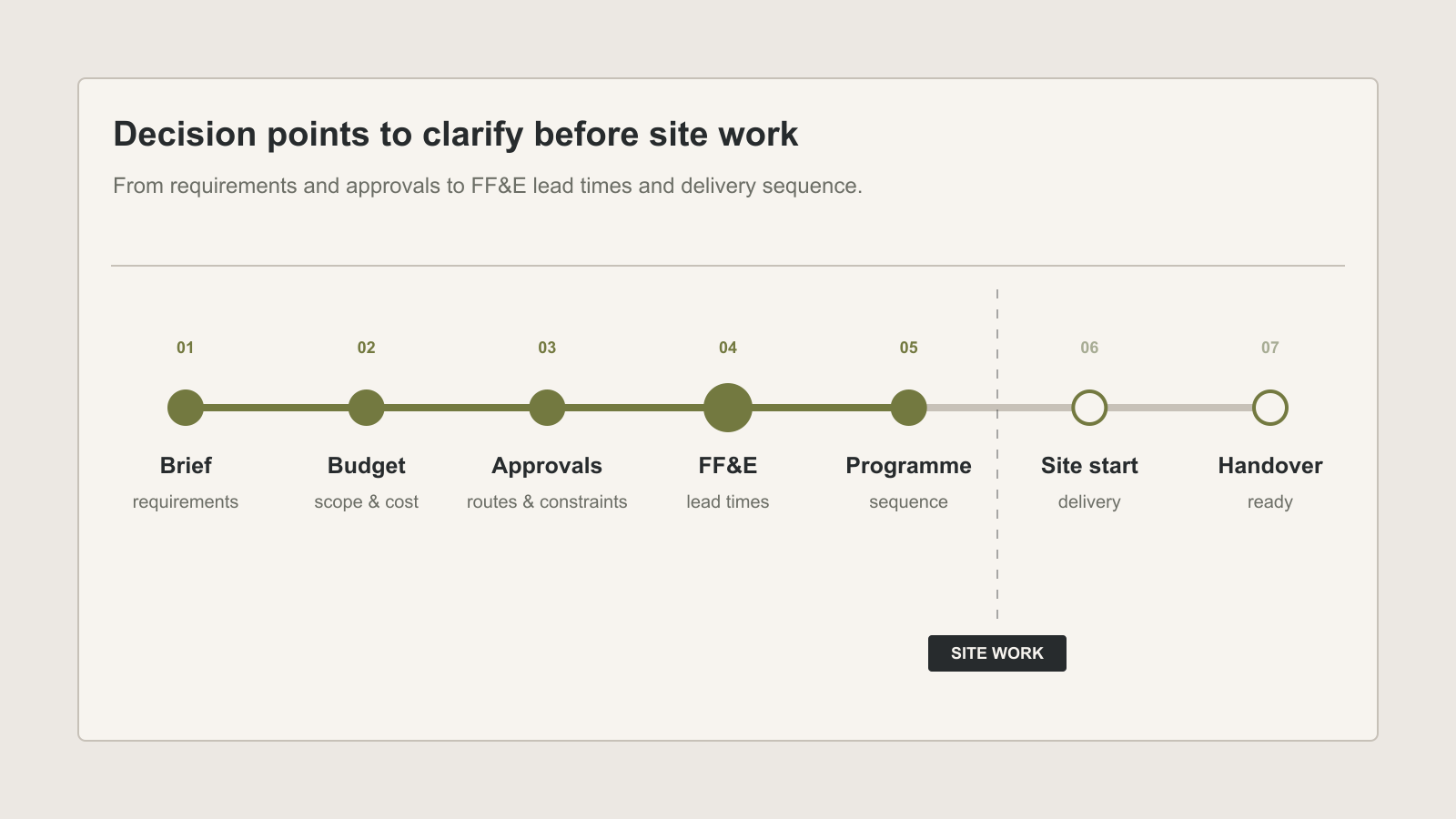
The project keeps moving, but not cleanly. Layouts are developed while requirements are still shifting. Costs are discussed before the scope is properly understood. Programme dates are assumed before lead times and approvals are checked. Suppliers are asked for information while the client team is still deciding what they need.
That is where risk starts to build quietly.
Late decisions reduce useful options
The problem with late decisions is not only that they cause delay. It is that they reduce the quality of the choices available.
If a meeting room requirement changes late, it may affect partitioning, furniture, AV, power, data, acoustics and cost. If furniture is selected too late, the best-fit products may not be available within the programme. If a landlord approval condition appears late, the sequence of work may need to change. If the budget was based on an assumed scope, the client may be forced into difficult value decisions when there is less room to move.
At that point, decisions become reactive.
Instead of asking "what is the right answer for the business?", the question becomes "what can we still do in the time left?"
That is not a strong place to make workplace decisions from.

Early clarity is not about slowing the project down
There is sometimes a concern that early planning adds time.
In practice, good early-stage clarity usually protects time. It gives the client team a better basis for decisions before the programme becomes tight and expensive to change.
That does not mean every answer has to be fixed from day one. It means the open decisions need to be visible. The team needs to know what has been agreed, what needs testing, what carries cost or programme impact, and what must be decided before the next stage can move forward properly.
A useful early-stage process should clarify:
What the workplace needs to support
Which requirements are fixed and which are still assumptions
What layout options are realistic
What the likely cost and programme implications are
What approvals, landlord constraints or building conditions may affect delivery
What furniture, acoustic, technology and storage decisions need to happen early
Who needs to be involved before scope is fixed
This gives leadership teams a clearer picture before they commit.
It also reduces the internal burden on the people trying to keep the project moving.
Decisions need ownership
One of the most underestimated parts of a workplace project is decision ownership.
Many client teams know what they want in broad terms, but they do not always know which decisions need to be made, when those decisions become critical, or who is responsible for making them.
That matters because workplace projects touch many parts of a business.
The managing director may care about direction, risk and business impact. Finance may care about cost, value and committed spend. Operations may care about disruption and continuity. HR may care about people, culture and change. Facilities may care about delivery, maintenance and practical use. Teams may care about focus, privacy, storage, meeting rooms and how the space will work day to day.
Without structure, these views can arrive late or compete with each other.
A good project process brings them together early enough to shape the brief, rather than letting them surface after key decisions have already been made.
Better projects start with clearer decisions
The aim is not to make a workplace project feel heavier than it needs to be.
The aim is to make it easier to control.
When requirements, constraints, costs, programme dates and decision points are understood early, the project has a stronger foundation. The client team can move forward with more confidence. Suppliers can respond to a clearer brief. The programme becomes more realistic. The risk of late compromise is reduced.
The build still matters, of course. Quality, coordination and delivery control are essential.
But many of the best delivery outcomes are protected long before anyone starts work on site.
If you are planning an office move, refurbishment or reconfiguration, the most useful question may not be "when can the work start?"
It may be "what decisions need to be made before the project becomes difficult to change?"
If you are considering an office move, refurbishment or reconfiguration, POS can help you clarify the brief, test realistic options and understand the practical route from first decision to handover.
Speak to us early, before late decisions become project pressure.